Here I show some of the main research I’ve done between 2020 and 2025. It features innovative methods for selecting suitable compute resources for any large-scale data processing workload. This work will conclude with a doctoral degree in late January 2026.
Research Problem
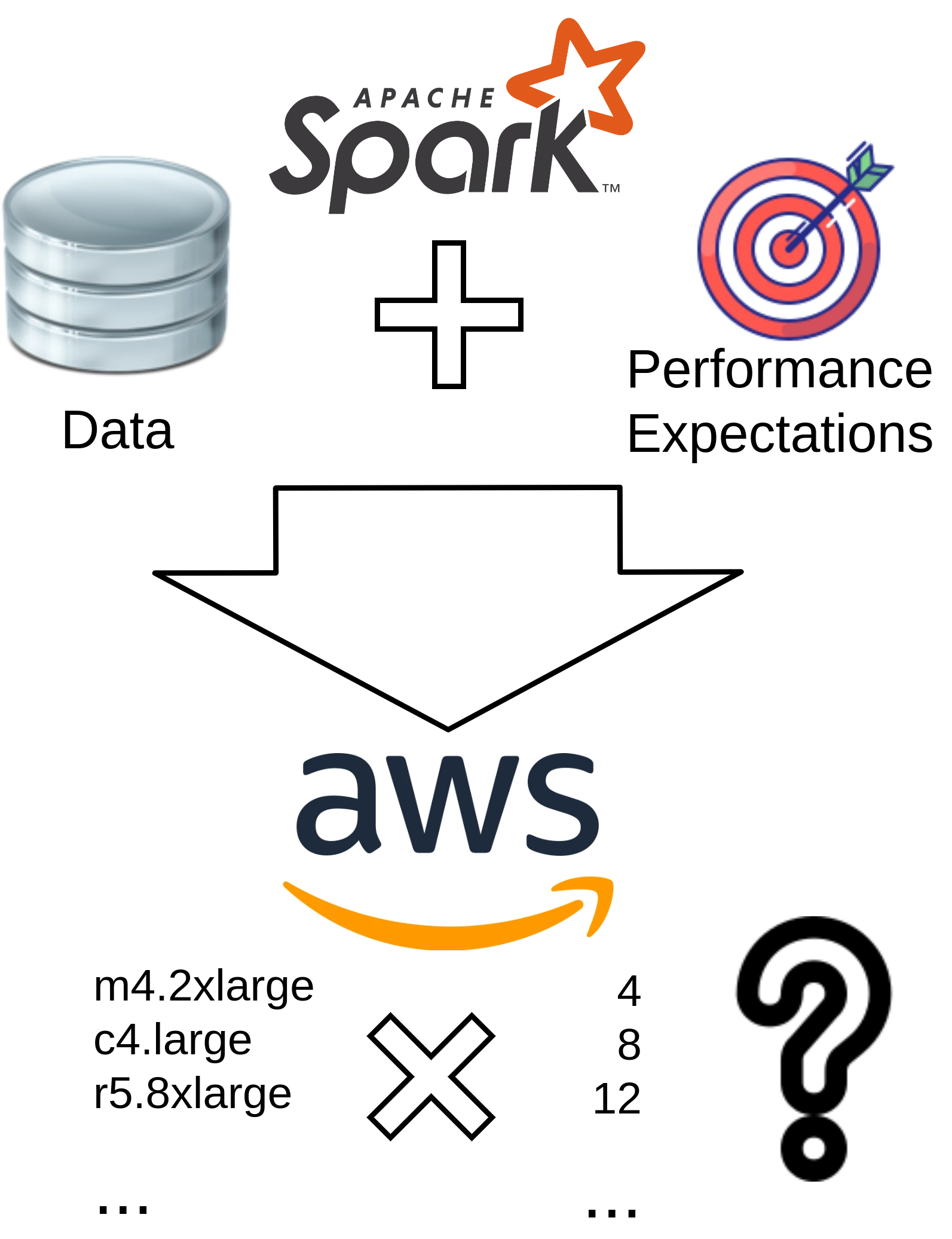
Distributed dataflow systems such as Apache Spark and Apache Flink enable data-parallel processing of large datasets on clusters. Yet, selecting appropriate computational resources for dataflow jobs –– that neither lead to bottlenecks nor to low resource utilization –– is often challenging, even for expert users such as data engineers. An efficient configuration of resources optimizes for low execution cost and low execution duration simultaneously. This is an optimization problem that many researchers around the world are currently working on.
Main Results
The following presents some of my main works tackling the
aforementioned research problem.
Towards Collaborative Optimization of Cluster Configurations for Distributed Dataflow Jobs [PDF]
This paper provides a problem analysis of model-based performance
prediction of dataflow jobs on different types of cloud infrastructures.
It identifies how different aspects of the execution context contribute
and draws conclusions for designing collaborative systems for sharing
performance metrics and performance models for data processing jobs.
C3O: Collaborative Cluster Configuration Optimization for Distributed Data Processing in Public Clouds [PDF]
This work identifies how different aspects of the execution context
contribute and designs a collaborative system for sharing performance
metrics and performance models for data processing jobs. It includes
system specifications and generalized performance models, which are
implementated and evaluated. By considering the broader execution
context, these performance models have shown better results than
performance models from related work.
Training Data Reduction for Performance Models of Data Analytics Jobs in the Cloud [PDF]
This paper discusses the sharing aspect of data, with a particular
focus on increasing resource efficiency when storing and exchanging
potentially large amounts of data.
Get Your Memory Right: The Crispy Resource Allocation Assistant for Large-Scale Data Processing [PDF]
This work focuses on appropriate memory allocation, since this has
shown to typically have the most significant impact on
resource-efficiency. Systems like Spark use memory for caching parts of
the dataset. Meanwhile, a lack of memory leads to more intensive use of
the disk, slowing down the processing. By conducting profiling runs on
reduced hardware, and on small samples of the input dataset, we can
extrapolate memory use of the full execution. The derived resource
configurations have shown high cost-efficiency when compared to related
work.
Flora: Efficient Cloud Resource Selection for Big Data Processing via Job Classification [PDF]
This most recent work uses statistical methods to in combination with
infrastructure profiling to predict resource options’ relative
posititions in the cost–duration space. It exploits the similarity of
resource preferences of jobs with similar memory access patterns. The
derived resource configurations have shown high resource-efficiency.
Further, this method features very low exploration overhead, when
compared to related work. Keeping this resource selection overhead low
is a central theme in my doctoral thesis, which will soon be published
here.
A complete list of more than 20 papers I co-authored during my time in research is available on my Google Scholar profile.